Hello everyone, I hope that this report finds you all well and either resting up from an outing on the water or getting ready for one. For me, I'm experiencing the former at the moment- resting up from a trip to Puerto Vallarta and the waters off of El Banco.
With me on this trip was my wife Nansea as well as two of my best friends Pete and Deke, along with their wives. For anyone that doesn't know me, I prefer to get off of the beaten path when we travel and this trip was to take us to San Pancho (San Francisco formally), a sleepy little fishing village just North of Punta de Mita and Puerto Vallarta.
In order to get there we flew into PV and instead of racing out of town we decided to spend the night at Marina Vallarta. For anyone who hasn't been it's a cool little spot with plenty of different hotels/condos for rent. The food is great, the margaritas are strong, and the vibe is terrific.
The view from our deck at the Flamingo Hotel

After a day of travel we decided to grab some provisions, toast the first sunset of the trip, and share some laughs.
Myself, Deke, and Pete

In the morning it was off to San Pancho so we loaded up the rental and hit the road. The ride was actually much shorter than we had expected and within an hour of travel time we were rolling into our little town for the week. This is downtown San Pancho…at rush hour…in a traffic jam.

The meter maids will really sneak up on you down here too

View from the road below
From the top floor
The pool side nap zone
The pool
And finally the tackle shop
After settling in it was once again time to relax, grab a cocktail, and salute the sunset before hitting the sack for the fishing that would follow.
Early the next morning we shoved off for Punta de Mita (about a 45 minute drive). One note for anyone who might venture down to San Pancho: there is an hour time difference between San Pancho time and Punta de Mita time so be sure to take that into account. For us that meant leaving at 5:15 to be there by 7am even though it was a short ride.
This was to be the first of three days of fishing with Lora of Fortuna Sportfishing, but unfortunately the fishing gods…or rather the engine gods had other ideas for us. We did make it out for a short bit, but one bum engine made it a no go and with the winds picking up we called it a day. Final tally for day 1 was a couple of flip flop mahi.
After Lora took a day to make arrangements for another boat, we headed out with reports of hungry yellowfin at El Banco.
We arrived early to a new boat, calm winds, and a fair tide.
While the wind was sputtering, there was still a residual sea and a few areas that the winds wouldn't give up so it was slow going, but after a few hours we reached the grounds and were greeted by birds, flying fish, and yellowfin that were trying their best to take flight.
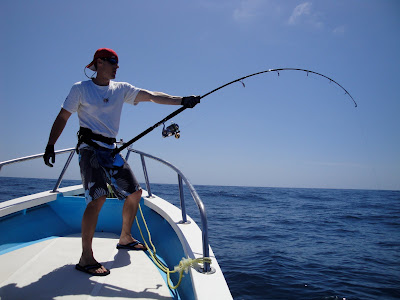
I was first up, put a Volador right in front of the mark, and was rewarded with an early morning Stella song before this 70# fish hit the deck.
We then casted a bunch of different things without luck before I put on a Shimano Ocea Pencil Bluefin Tuna and hooked up again. Pete, Deke, and myself all took turns fighting this fish and it gave us all a new respect for yellowfin.
After that the casting bite shut down so we tried jigging with regular jigs as well as Lucanus but had no love. Deke and Pete both wanted to put a bend in their new jigging rods (Pete bought a WGJ and Deke built his first jigging rod for the trip) so Lora hooked them up with some caballitos and we found the right school. Pete and Deke doubled up and fighting their fish.
It was a heck of a day and we had an absolute blast. The final tally for the day was 5 for 5 on yellowfin ranging from 70-120#. The gear we fought on was Zenaq 76-7/Stella 10000XG, a WGJ/Saltiga 40, and a custom/Saltiga 40.
This trip gave us all a new appreciation for what yellowfin in deep water can do, and for the importance of hiring a good captain. Even though we wouldn't make it out for a third day as Lora was trying to get his boat squared away, he worked his tail off to put us on the right fish- Thank you Lora!
After getting back to Casa Canto del Mar we saluted our quarry for a good fight and a lifetime of memories, poured a cocktail, and enjoyed the fruits of our labor and another sunset.
In my mind, San Pancho, Punta de Mita, and Captain Lora is a winning combination and I can't wait to hit the numbers again.
Jigstrong!
Shoe